Art as Emotional Recovery
It Must Be Love: A Mustang Prairie RomanceArt as Emotional Recovery is the book’s account of Jack Thorpe’s creative revival after grief, domestic trauma, and a year of artistic paralysis. His return to painting is not a simple restoration of his former success: it begins with failed attempts, passes through an experiment in metalwork, and becomes possible only when Trixie Beaumont reawakens an intensity he had been unable to reach alone. Art therefore records Jack’s emotional recovery while also changing the way he understands desire, memory, family, and the possibility of a future.
From Acclaimed Painter to Creative Block
Jack had once taken the art world by storm at twenty-two, selling dozens of oil paintings for extravagant sums. That history made his later inability to paint more painful. After moving back to Mustang Prairie so Abby Thorpe and Andie Thorpe could have the safe, idyllic childhood he remembered, he established a studio and tried to resume his old practice. For a month he attempted to produce something significant or evocative, but the results were limited to fruit, grass, flowers, and his daughters. The pictures were competent, yet he felt that none possessed the value or force that had defined his earlier work.
The failure affected more than his productivity. Jack experienced his departure from oil painting as almost a betrayal of the medium that had made him wealthy and famous, even as boredom and exhaustion with paints and canvas had become impossible to ignore. The contradiction is central to the concept: the artistic identity that once secured his success had hardened into a comfort zone, while the safe home he created for his daughters offered emotional stability without restoring his imagination.
Metalwork as a Transitional Medium
The first opening came from an unexpected source. Walking along Fourth Street, Jack noticed a strange metal table displayed in Trixie’s lingerie shop. The object produced the insight that his studio work could move beyond the established language of oil paint. Two days later he had gathered supplies, and after roughly a dozen attempts he began to understand the new process. A chandelier he had sketched gradually took shape, giving him a physical task in place of the blank canvas that had defeated him.
The change of medium was not presented as a triumphant rejection of painting. Jack remained uncertain about whether the metal-and-wood experiments would lead anywhere, but the work restored movement to his practice. When Trixie asked how the new medium was working, he attributed the change to boredom and admitted that nothing had inspired him and that everything he painted had seemed worthless. Her response helped distinguish the problem from lack of ability: she recognized that his earlier work was visceral, emotional, and passionate, and she wanted to see whether the chandelier could carry that same force. Jack, in turn, said that the piece was nearly finished, suggesting that experimentation had begun to loosen the block.
Trixie and the Return of Perception
Trixie’s presence becomes the decisive emotional catalyst. Jack is drawn not merely to her appearance but to the way she treats his daughters: firm without being harsh, nurturing without coddling, and encouraging in a way that makes them feel respected. Abby brings Trixie a photograph found in the basement and asks for a hat like her mother’s, Marissa Thorpe’s. Trixie helps her make it, photographs Abby and Andie wearing it, and places the new image beside the visual memory of Marissa. The handmade hat and the photograph turn creative labor into a form of family remembrance.
Jack sees the effect on Abby. The photograph becomes important enough for her to demand a frame, and she keeps it beside Marissa’s picture. Later, Abby explains that Trixie makes things for the girls, speaks to them as capable older children rather than babies, and has given her good memories of her mother. This domestic creativity becomes part of Jack’s renewed perception: Trixie’s work does not erase Marissa, but gives the children a new way to hold their mother’s memory.
The same encounter that makes Trixie valuable to Jack’s family also unsettles his senses. After their near-kiss, he cannot stop recalling her body, her touch, and the sandalwood-and-lavender scent associated with her. Desire enters his consciousness as an image-making force, not as an interruption separate from art. He finds himself unable to see the chandelier because he can see nothing but Trixie, and the stalled metal project gives way to a renewed need for paint.
The Erotic Painting and Emotional Disclosure
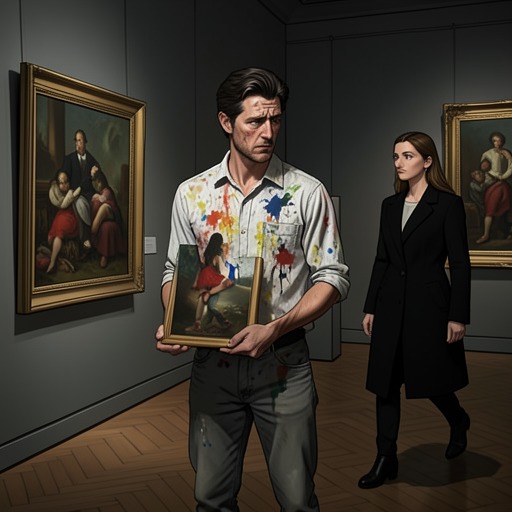
Jack’s return to the canvas is immediate and instinctive. An image forms in vivid colors: long red hair matching Trixie’s, pale freckled skin, and an erotic but playful, seductive, enchanting figure. His body remembers the procedures of painting even before his mind can fully explain the image. He dips the brush, works across the canvas, and continues until physical fatigue replaces the earlier blankness. The painting does not resolve his feelings, but it gives them form, allowing sensation, attraction, tenderness, and creative energy to occupy the same composition.
This work also reveals why Trixie has become more than a passing temptation. Jack’s response to her is connected to the emotional quality he had lost: intensity rather than technical competence, passion rather than routine, and a sense that the subject matters because it changes him. His artistic recovery is therefore inseparable from the risk of acknowledging desire after Marissa’s death and from confronting the possibility that love might not be exhausted by his previous marriage.
Jack’s mother identifies the obstacle directly when she tells him that Trixie may need to hear the truth about his marriage. She describes the tension, anger, and resentment that had existed between Jack and Marissa, while warning that Trixie is effectively competing with a ghost. Jack insists that his failed marriage has made him unable to attempt marriage again, but the conversation exposes the difference between refusing commitment and recovering from a particular relationship. Painting allows him to express what he cannot yet explain in speech; the canvas becomes an indirect confession before he can make an explicit one.
Art, Memory, and a Possible Future
The later gift of Blue Skies gives the concept a second dimension. Jack presents Trixie with the original of her favorite painting, and the gesture moves beyond erotic inspiration into deliberate emotional communication. Trixie’s tears show that the painting carries the weight of both the object itself and the affection she associates with its maker. At the same time, the gift threatens her attempt to suppress her love for Jack, demonstrating that art can heal one person while intensifying another’s vulnerability.
The family’s response places Jack’s creative and emotional recovery inside a broader network. During Thanksgiving, his house is full again: his parents remain in town, Sadie and Dylan bring food, Luna arrives with a ham, Jonquil Spring joins Abby and Andie, and Trixie appears only shortly before the meal after trying to avoid Jack. The gathering contrasts with the isolation of his studio and shows that recovery is not purely solitary. Yet Trixie’s avoidance also demonstrates that emotional renewal creates new conflicts; Jack’s recovered desire does not automatically provide clarity or security.
By the time Trixie is developing new Valentine’s Day designs, Jack’s words at Christmas and Blue Skies remain in her thoughts even as she denies that they matter. Her black-and-pink bustier and the growing activity of her shop place her own creative work beside Jack’s painting. The book thus presents artistic recovery as reciprocal rather than one-sided: Jack’s art is reawakened through Trixie, while Trixie continues building an independent lingerie business through design, production, and controlled quality. Their creations preserve memories, organize labor, and make desire visible, but they also expose the unfinished emotional work neither character can avoid.
Art as Emotional Recovery ultimately means a return to feeling through making. Jack’s art moves from celebrated oils, through uncertain metalwork, back to a painting charged by Trixie’s presence; Trixie’s handmade objects and lingerie designs reshape the Thorpe family’s memories and her own independence. The concept’s significance lies in that double movement. Art does not simply represent healing after grief. It becomes the practice through which Jack begins to perceive again, Trixie receives evidence of his inner life, and the family discovers that new images and objects can preserve the past without remaining trapped inside it.